10. Day Eighteen
You may have been surprised when I admitted to being a Michael Jackson fan, but I have another confession to make. I am a Trekkie. And after many years of being totally purist and insisting on only watching the orginal series, I have discovered The Next Generation and I like it. I remember when I saw it for the first time all those years ago, I couldn’t stand Captain Picard. I thought the man who played him was a terrible actor. Well he is really. But now, a week before my 50th birthday I realise that bad acting doesn’t bother me like it used to. And in any case, Star Trek was never really reknowned for the superlative acting skills.
My son likes The Next Generation as well. When he said to me he wanted to watch Star Wars I said, try this instead. Less shooting at each other, more humour and good storylines. But actually TNG is meant to be for 12 year olds and above. So you might often catch me late at night, when Jaime is already in bed, reviewing a TNG episode to see if its suitable for his young sensibilities. Well, it’s a good excuse to have to watch Star Trek.
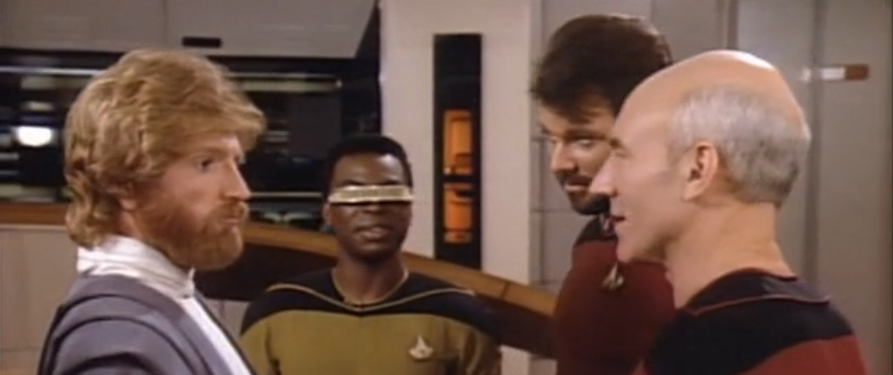
The other night I watched “Loud as a Whisper” from the second series. And I was surprised by a moment that spoke to me in a way I had not expected. Riva, a deaf and dumb mediator who communicates through the help of a “chorus” of three people who can read his thoughts, has been mandated to settle a 15 century long conflict between two factions on some far-flung planet. During the briefing on board the Enterprise he talks about how to mediate in a conflict and it is pointed out that the conflict parties have been at war for so long, it has become personal. And he says “The basis for peace must also be personal”.
That brought me to thinking about an old favourite of mine: the political and the personal. In what way is one driven by one’s personal biography to hold a political position? Like Emma Goldman said “If I can’t dance to it, it’s not my revolution”. So I often stop and look at parallels between my personal and my political life.
One of those was when I gave up smoking. I got the idea that I could write a series of self-help books on nuclear disarmament. “The Easy Way to Give Up Nuclear Weapons” for people addicted to having ultimate power over others. Learning how to reverse the brainwashing of nuclear deterrence sold to us by the military-industrial complex.
Here is a breakdown of what such a book might look like:
The IPPNW Easy Way to Give Up Nuclear Weapons
Confronting the Addiction to Power
1. How the method works
Don’t concentrate on the reasons why nuclear weapons are bad for us: the money, the slavery, the health risks, proliferation, etc. We know that already. Instead we concentrate on why states continue to possess nuclear weapons despite these obvious and well-known facts.
2. It is fear that keeps the nuclear weapon possessor hooked!
Fear of losing their status and power in the world or of being open to attack by another state. Fear of the effort needed to become free of nuclear weapons.
3. We remove these fears, to be FREE
After becoming nuclear weapon-free, using the IPPNW method, states enjoy the satisfaction of a new and morally improved image, a huge sense of relief, an increase in trust, and very large amounts of financial resources become available to spend on employment, education and health.
4. Reversing the brainwashing that led states to go nuclear
We don’t need nuclear weapons for our security. They don’t make us look smart.
5. Going from deterrence to empathy
How to talk to states so they will listen and listen so states will talk. Just like we don’t threaten our kids with violence when they don’t do what we say, we should use new methods for dealing with each other.
6. The Health Dividend
Nuclear weapons are very bad for our health. Without them, radiation levels are bound to sink and will be freed from the risk of annihilation.
7. Lots more money for better things!
Just think of the billions that we can spend on health and education. Maybe we will at last have enough money to spend on ridding the world of malaria and AIDS, real threats to our security.
8. “Light” nuclear weapon states
Those with only a few find it hardest to give up because they feel the big possessors should cut down first. But they are addicted just as badly.
9. Co-Dependency and Denial
Those in alliances are just as hooked. The NATO addiction. UK is in denial when it believes it is “independent”.
10. The nuclear industry profits from proliferation
The trojan horse of so called civilian nuclear power. How the only countries really interested in nuclear power are those who want the nuclear weapons “option”, and the industry knows it. (Parallel with the tobacco industry knowing how addictive nicotine is).
11. Listen to those who are free
Quotes from politicians in New Zealand, South Africa, Libya. The community of nuclear weapon-free zones.
And so on. You get the picture. Maybe I’ll get round to writing that one day. It was fun thinking it up, in any case.
But turn it round the other way. Not only applying the personal onto the political, but what does the political do to us personally? What does it mean if you are an activist and you spend most of your life trying to change the world for the better? It is so easy to lose yourself within that vocation and identify with it so much that it becomes us. What am I? Disarmament expert. And all the other things take second place. Mother, wife, writer, actress, painter, gardener, family historian.
My son is always trying to drag me away from the computer. In normal homes, it’s the other way round. The kids play a game on the trampoline called “atomic bomb” in the garden. If the ball falls on the ground, then they all fall down dead. That comes from my son, who never talks about ordinary bombs. They are always nuclear. When he was five, the Mayor of Hiroshima came to Berlin and he wanted to know why I had to spend so much time with him. So I told him about Hiroshima. He was probably the only five year old in Germany who knew what happened in Hiroshima in 1945. Is that good? I don’t think so. He goes around taking toy guns off the other children and throwing them away. But they know why he does it. It’s because of his mother. Even they try to explain to me that I don’t have to worry, the guns aren’t real. As if I didn’t know.
The story of the military psychologist in Fort Hood haunts me. He didn’t want to be posted to Iraq. Some say he had arguments with other people on the base because he was against the wars in Iraq and Afghanistan. The first is personal, the second political. Who knows what came first. But it becomes very personal when the shooting starts. For everyone concerned. And then when the shooting stops, it becomes political again. What the media reports, what the consequences are, what we are led to believe. Someone wants us to know that he was a Muslim and regularly attended the Mosque. It is rumoured that he posted stuff on the internet about suicide bombings. They don’t say whether it was in favour or against. They report that maybe it wasn’t even him that wrote them. We are offered pieces of a puzzle that add up to a picture that is pre-planned.
A young colleague writes “the existence of nuclear weapons hurts my heart”. I can only say we have a duty to ourselves to remain unbroken in the face of so much that is broken.
 X-FACTORED
Leave a comment