At my age a thought starts to emerge like a small moth flapping at the window: what will it be like to age, to die? It is not a great age, fifty-one, but it is an age where one can speak of experience. More than half a century to look back on, five times older than my own child, a wealth of images and memories, some of which I can’t find any more.
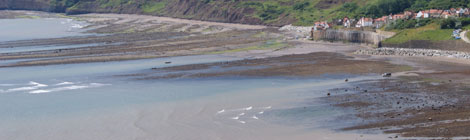
Yesterday we strode out onto the beach, me with my sticks and my expensive walking shoes, with a mind to walking. It was to be an easy walk, easing ourselves in slowly with a view to longer, harder walks, maybe even to Whitby. The sign here in the Bay says it is only three miles to Ravenscar. So off we went, the sun shining, but neglecting any cream to protect against it, along the sand, sidestepping the rocks.
I set the tempo, a good nordic walking speed. It felt purposeful, a strong stride, healthy. My husband and my son had no trouble keeping pace with me, however. Obviously it was only subjectively fast. Soon they began to hang back, eyes peeled on the ground, picking through the stones for fossils, for there are a great many here. The boulder clay and shale cliffs of this North Yorkshire coast, backing up the moors, coughing up its geological history in little mementos of ammonites and dinosaur claws from the Jurassic period. Holding a petrified creature that is millions of years old makes my paltry half a century seem irrelevant.
There are several classes of kids on geography trips on the beach. I came here as a child too, with measuring sticks and grids, wearing a uniform and calling „Sir, sir!“ to our geography teacher, whoever he was. Was it then that I fell in love with this place, or that holiday in the little house on the disused railway line up at Ravenscar, or much later as a rowdy teenager looking for drugs in the Bay Hotel and only finding herbal highs made of passion-flower that made you feel sick from the immense quantities it was necessary to smoke in order to at least get the impression of being drugged? Or maybe the combination of those visits and the later ones as an adult were what made me so besotted.
My legs were doing well, I thought, as I passed Boggle Hole. Last year I only got that far and had to turn back, I was still so weak from the illness. This year I was made for greater things, longer walks, higher climbs.
The further down the bay you go, the emptier it gets, till we were soon on our own. The rock formations with their crab-filled rock pools, adorned with seaweed beds and interspersed with sand or broken-up shale or pebbles, lead the way. Beware of following a rock spit and ending up surrounded with water, nowhere to go but all the way back. And getting too close to the cliff is also inadvisable, with its constant shedding of rock. So we picked our way through this natural obstacle course to the end of the bay, unsure how we would get up the cliff to return along the Cleveland Way.
And as it always is, we think the next bend or jutting-out cliff face will hide the path we are looking for. But when we are there, there is no path, just more cliff face, impossible to climb and the rocks below are becoming more inhospitable to our feet. I am mighty glad of the sticks.
Then we meet some people coming the other way and my son rushes to them, asking if they found a path down the cliff that we might use to go up. Yes, they say, just around the end of Peak Steel that marks the end of the Bay, there is a path, steep but walkable.
Now at every step another fossil winks up at us, the rock rich in natural history, but threatening to turn your foot and break an ankle easy enough. My son springs from rock to rock like the little mountain goat he is and my husband has taken the usual lead that is impossible to catch up to. One time on the island of Hoy in the Orkneys he was so far ahead I lost sight of him for hours and could only follow what might have been his smell, like a dog looking for its owner. He had the bottle of water in his bag and I had a terrible thirst. Since then I always make sure I have my own water. And the joke on that immense Hoy walk was that he had promised me there would be a tea room at the other end. All there was to be found was a beach full of rocks taller than myself, perfectly rounded, like the pebbles of giants and all different colours. No tea room and no bus to get back.
At least this time I knew that at the top of the cliff there was a tea room, or even a hotel with a lounge bar that served sandwiches, with a vista of the bay that could not be beaten. But first to scale the cliff that in olden times was the destination of the Lyke Wake Walk, the funeral walk forty-two miles across the moors at the end of which they would bury the coffin atop of the cliff, only for the sea to claim them back in later years as the cliff eroded.
As I began to climb, I was on my own and I soon realised this was not the path the walkers had pointed us to, that was further round the point. I was at the sharpest end of the point and needed to use my hands and the strength of my arms to ascend. I knew that slipping could, at the least, mean broken bones, and it reminded me of climbing the mountain behind our house on Mull for the first time alone, when I slipped and fell a small way, coming to stop just before a fatal drop. I was just a little older than my son is now, I think. A moment when I quite clearly understood how easy it is for life to simply end. And then what? The next one begins? Or nothing happens? Hard to believe with all that perfection of nature around, singing out meaning with every breath, that nothing more would come.
I did not think about death this time, but about living and most of all about climbing, the challenge of it, feeling strength in my arms and legs. And I was just past the most dangerous patch, back on two legs and panting with the exertion (and some realisation of fear) when my son and husband came around a bend, applauding my effort, amazed that I was back in the land of the healthy.
This morning at the Dock, watching the high tide bash against the sea wall, eating my toast, that little moth of a thought was there. Of course, aging means that the body makes itself heard with aches and pains, slowing you down. The stairs in the house force my legs to take them one at a time. The illness, however, is receding. There is some hope that I will find a normal life for a woman of my age, with a touch of arthritis in her knees and toes, and a desire to go on living for a good long while.


 X-FACTORED
Leave a comment