50th anniversary of last atmospheric nuclear test “Tightrope”
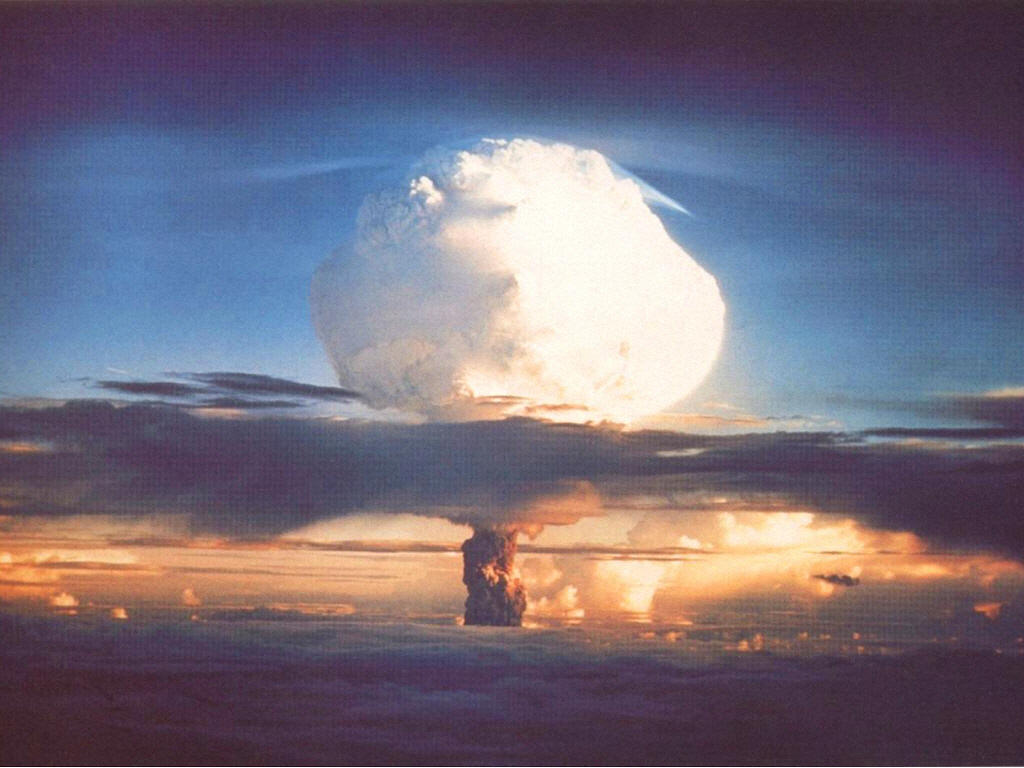
Fifty years ago today, “Tightrope” the last of 215 US atmospheric nuclear tests took place. This was the final blast in one of the worst chapters in nuclear history that began sixty years ago, on November 1st 1952, when the first hydrogen bomb was tested on an island in the Pacific Ocean. That island no longer exists. It was called Elugelab and was part of the Enewetak Atoll in the Marshall Islands. The enormous power of the hydrogen bomb – equivalent to 10.4 megatons of TNT – literally blew the island away, leaving only a crater. The massive fallout it produced contaminated all the islands of the atoll. Planes were flown through the radiation cloud to measure its intensity and take onboard samples. Seabirds died of radiation sickness.
Between 1948 and 1958, 67 nuclear bombs were exploded in the Marshall Islands, 43 of which were conducted on or over the Enewetak Atoll, the rest on the Bikini Atoll. Two of Enewetak’s islands were vaporised. The islanders were forced into exile for over 30 years and the Northern part of the atoll remains uninhabitable.
‘The equivalent of 1.6 Hiroshima bombs was dropped on our tiny country every day of the 12-year test period,” said Jack Ading, the Marshall Islands Finance Minister and Enewetak’s senator. Even today, after the islands have been decontaminated, the islanders are still concerned about the safety of their environment.
Ten years ago it was reported that the US dump for radioactive waste on the island of Runit, where the radioactive debris from the decontamination was deposited – was beginning to crack up. The waste, mixed with slurry, is inside a crater, left by one of the eight nuclear tests conducted on the tiny island, and covered by a huge concrete dome. Noone is allowed to visit Runit for at least the next 24,000 years – the half-life of the plutonium encased in it. Any seepage from the dump could have severe effects on the maritime environment that the islanders depend upon for their livelihood.
The Bikini Atoll in the Marshall Islands is still uninhabitable. In 1968, the US declared the atoll habitable and the indigenous people began to move back. However in 1978, levels of strontium 90 were found to be so high in their bodies that they had to leave again. This contamination resulted in severe health effects, particularly in pregnancy and birth, causing a rise in birth defects. Thyroid cancer became rife among the children of the island of Rongelap.
The last US atmospheric test – “Tightrope” – took place fifty years ago today, on November 4th 1962 near Johnston Atoll. That chapter of nuclear history was closed for most of the world with the Partial Nuclear Test Ban Treaty in 1963, with the exception of French Polynesia who continued to suffer from French atmospheric nuclear testing until 1974. Johnston Atoll never had any indigenous human inhabitants but it had plenty of wildlife. In 1926 it was designated as a federal bird refuge and later it became a wildlife refuge. The island is visited by many different kinds of seabirds, green turtles and Hawaiian monk seals. Significant contamination issues still exist that threaten wildlife, not only from plutonium from abortive nuclear tests but also from chemicals weapons disposal, including Agent Orange, and heavy metals, which have all migrated from land to the marine environment and can be found in the fish.
Polly Higgins, a Scottish barrister, is fighting for a law of “ecocide” to be recognised by the International Criminal Court as a crime against peace. Above-ground nuclear testing is one of the worst examples of ecocide in the whole of history. The use of nuclear weapons in war would doubtless be another. This is why, she argues, it is necessary to establish a legal duty of care to prevent ecocide occurring again. In the view of the International Campaign to Abolish Nuclear Weapons (ICAN), the only way to prevent such catastrophic humanitarian and environmental consequences is to ban nuclear weapons in the same way that chemical and biological weapons are banned.
Published on allvoices.com, Nov 4, 2012
 X-FACTORED
Leave a comment