Helen Chambers (1842-1914), maternal 2x great Grandmother
My 2x great-grandmother Helen Chambers1 was actually named Ellen on her birth certificate, but on her baptism record, the name “Ellen” is crossed out and replaced with “Helen”. The name “Ellen” refused to go away, however, and appeared again on the 1851 census and the 1913 electoral register. I am not sure which of these two names she preferred, but I will call her Helen.
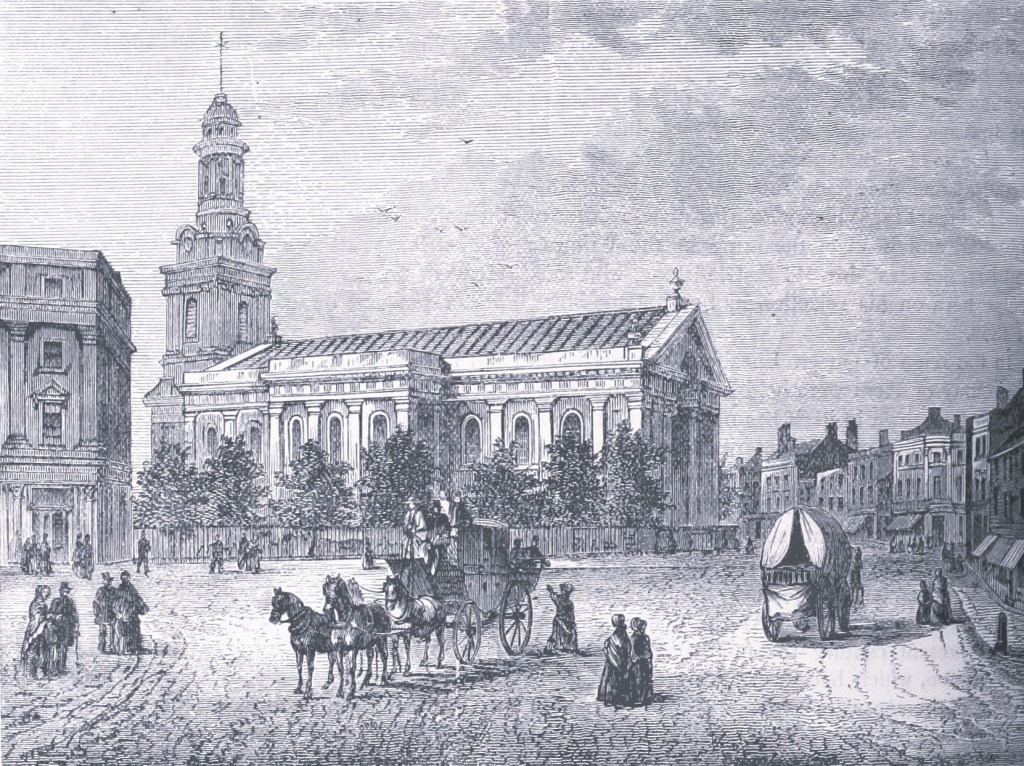
Born in Greenwich on 27 Sep 1842, she was the 5th of 10 children by two mothers. Her father was a Lieutenant in the Royal Marines and was most likely often away from home, although he had no problem conceiving a child almost every year. At least one child from his first marriage died young, Charles Stanley, before Helen was born.
Helen’s first loss was her mother: Caroline Chambers nee Dutton. Caroline had seven children before she died at the age of 35 in 1852. She died of “fungoid disease of the womb, unknown”. A fungal infection in the uterus would not have led to death, but it could have been a lymphoma in the uterus or, less likely, uterine blastomycosis.

Helen was just 10 years old and her younger brothers, Walter and William only seven and five, when their mother died. It is quite likely that Helen and her elder sisters Julia and Annett were required to look after the younger children for at least the first year after her mother’s death.
The following year her father remarried: Agnes Beeby (nee Carstairs), an engineer’s widow with a small son. Her Scottish stepmother gave her three half-brothers and sisters. Whether there was any filial love between them, or if Agnes was a good mother to them, nobody knows. But by 1861 Ellen had become Helen, aged 19 and a teacher, like her sister Annette. She was boarding in Guildford, Surrey. However, she didn’t remain a teacher for long.
On August 10, 1863, 23 year-old Helen married Edward William Ruegg, son of Richard Ruegg, a Clerk in the Customs Office. Edward was a government Clerk soon to become a Clerk with the Admiralty. The connection was quite possibly made through their fathers, maybe it was seen as a good match for his youngest daughter from his first marriage, since a job in the Office of the Lord High Admiralty was sought after.
On 22 Jan of the following year Helen’s firstborn son, named Edward William after his father, died of icterus (jaundice, most likely caused by liver dysfunction). He lived only nine days, eight of which he was critically ill and had convulsions. Since there were less than six months between wedding and birth, he may also have been premature, or he had been conceived before marriage. He was buried on 27 Jan 1864 in Greenwich.

Nine days, Helen would have held her first baby. She would have cradled his little yellow body, held his tiny hands, and watched him shake with convulsions, before he finally left her. Mary Wilson, possibly a servant, of 17 Wellington Street (Woolwich) was the informant, suggesting that Helen could not register the death at 7 Longstone Terrace (Church Street East) herself.
Close on the heels of this death, Helen’s father also died, at 53, of bronchitis and dropsy. Now, at 24, Helen was a full orphan and had lost her first child.
With the next three children she had more luck: Helen’s second son was Alfred James, my grandfather, who was born in 1865 and survived (good for me!). Two more sons, Edward Heathcote and Charles Parker, followed in quick succession from 1866 to 1868.
In 1870 her first girl, named Helen (after herself) Maud, was born. Helen Maud was six months old on 2 April 1871 when the census was taken. It shows a full house: Helen and Edward William and his brother, their four children, Annette Montague, her sister-in-law and Annette’s daughter Helen, Mary C. Boardman, a general servant, and a friend of her husband. 11 people were living in the house at 35 Upper East Street. Helen Maud died not long after, and was also buried in Greenwich Cemetery.
Her second daughter, Annett (named after Helen’s sister) Eleanor was born in April 1872. Helen must have been heavily pregnant with her when Helen Maud died. Annette Eleanor died four months later of diarrhoea and inanation (physical wasting due to starvation).

Of the next three girls, only one survived to their fifth year: Edith Rose (she died in 1968). Julia May was four years old when she died.

Clara Annabel was two. They both died in the first quarter of 1878 from scarlet fever, a major cause of childhood mortality at that time in and around London. After 1880 there was a drop on cases of scarlet fever, believed to correlate to the fall in wheat prices and the improvement of nutrition.2
Helen’s last two children also died: Francis Ernest Ruegg on 10 Aug 1880 of tubercular meningitis at four months old.

And little Norah, who was premature, and died on 1 Jun 1882, just four days old.

In the time between 22 Jan 1864, when her first child was born, already ailing, and 5 Jun 1882, the burial of her last child, Helen had watched seven of her thirteen children die. She had no time to grieve her dead children before she was pregnant with the next. Sometimes she was grieving while pregnant.
In 1911, she wrote the numbers on the census form: 13 children, 6 living, 7 dead.
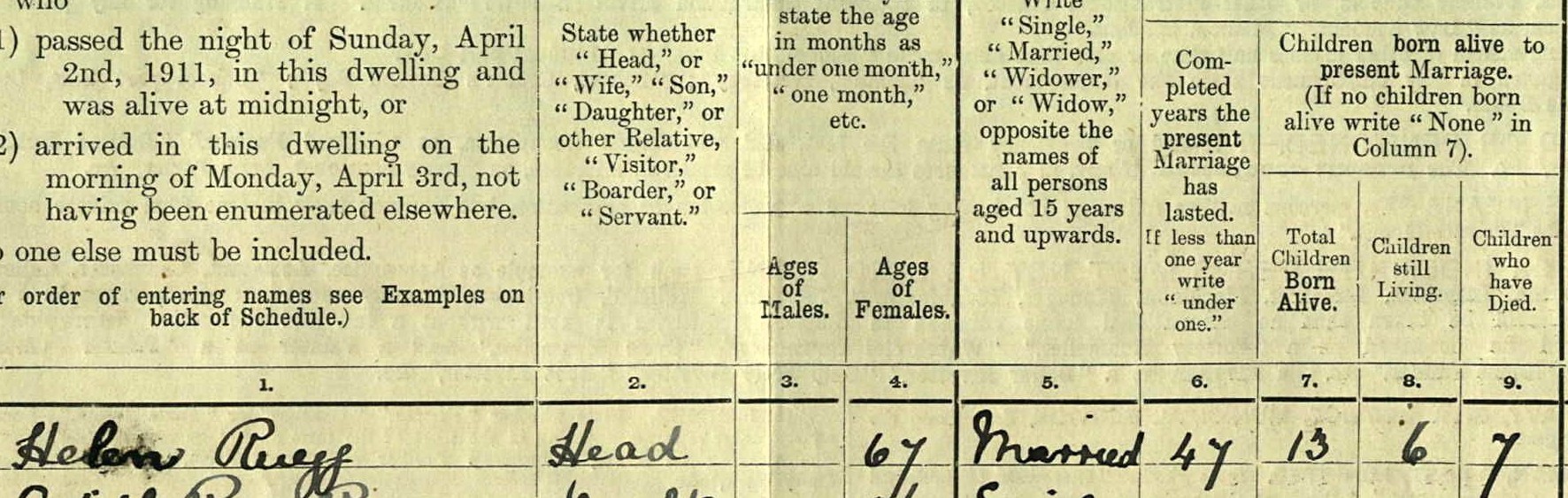
The ones that survived were: Alfred James, Edward Heathcote, Charles Parker, Edith Rose, John Louis, and Ethel Daisy. They all outlived their mother.
How did Helen live with all of this tragedy? While her husband, Edward William, had risen up the ranks of the civil service and became a Higher Division Admiralty Clerk, nothing is known of how Helen coped with all her loss. Certainly, the family was comfortable, as Edward brought in a good salary, and they could afford a domestic servant. By 1901, Edward had retired from his position as Superintending Clerk at the early age of 56, and had taken a house in Prittlewell in Southend-on-Sea. Helen was still living with him at this time, as well as their two living daughters, now 26 and 21, both unmarried.
By 1911, Edward and Helen appear to be living apart. They had been married 47 years. Whether they lived apart all or only part of the time, we do not know. But Edward was living either in a house in Streatham or on Hill Farm, Ashingdon, in West Rochford. According to the 1911 census, he lived alone at the farm in six rooms. His other address in Streatham, 40 Fernwood Ave, remained the same from 1907 until his death in 1923.
Helen was living in Wolfington Road, West Norwood, only half an hour’s walking distance from Edward’s house in Fernwood Avenue, with her two daughters, who had remained unmarried at 36 and 31. Ethel Daisy had become a Clerk. Also, Helen’s grandson Edward Brice Ruegg (15, also a Clerk in an engineer’s office) was living in the house, which had seven rooms. Edward Brice was Edward Heathcote’s son, who had perhaps been sent to live with his father’s family to learn the ropes as a Clerk.
Helen was registered to vote in the local government elections in 1913, the year that the Women’s Suffrage Bill was defeated in parliament. Although she was still married, she had somehow managed to get on the electoral register. Whether this indicates that she was politically interested, or active for suffrage, is not known. But the fact that she registered at all shows that she was not a passive woman.
Helen died on 20 Jan 1914, aged 70, in a nursing home in Croydon. She died after an operation to remove her gallstones of heart failure.

Writing this post has made me acutely aware of the intense loss that Helen must have suffered. Her resilience must have been quite incredible to be able to go on with her life, but perhaps having the other children was able to put her grieve aside to care for them. It is impossible to know whether Edward was supportive of her loss, or if he suffered greatly himself. Losing her mother so early meant she did not have her support, but she did have two sisters: Annett and Julia. Annett features at least on the 1871 census as living with Helen, so it can be assumed that they were close.
Helen was buried in Greenwich cemetery (Shooter’s Hill). On one side of her headstone the names of five of her children who died young are engraved: (Helen) Maud, Annette, Julia, Clara, and Frank (Francis). Where Edward William and Norah now lie, we don’t know.
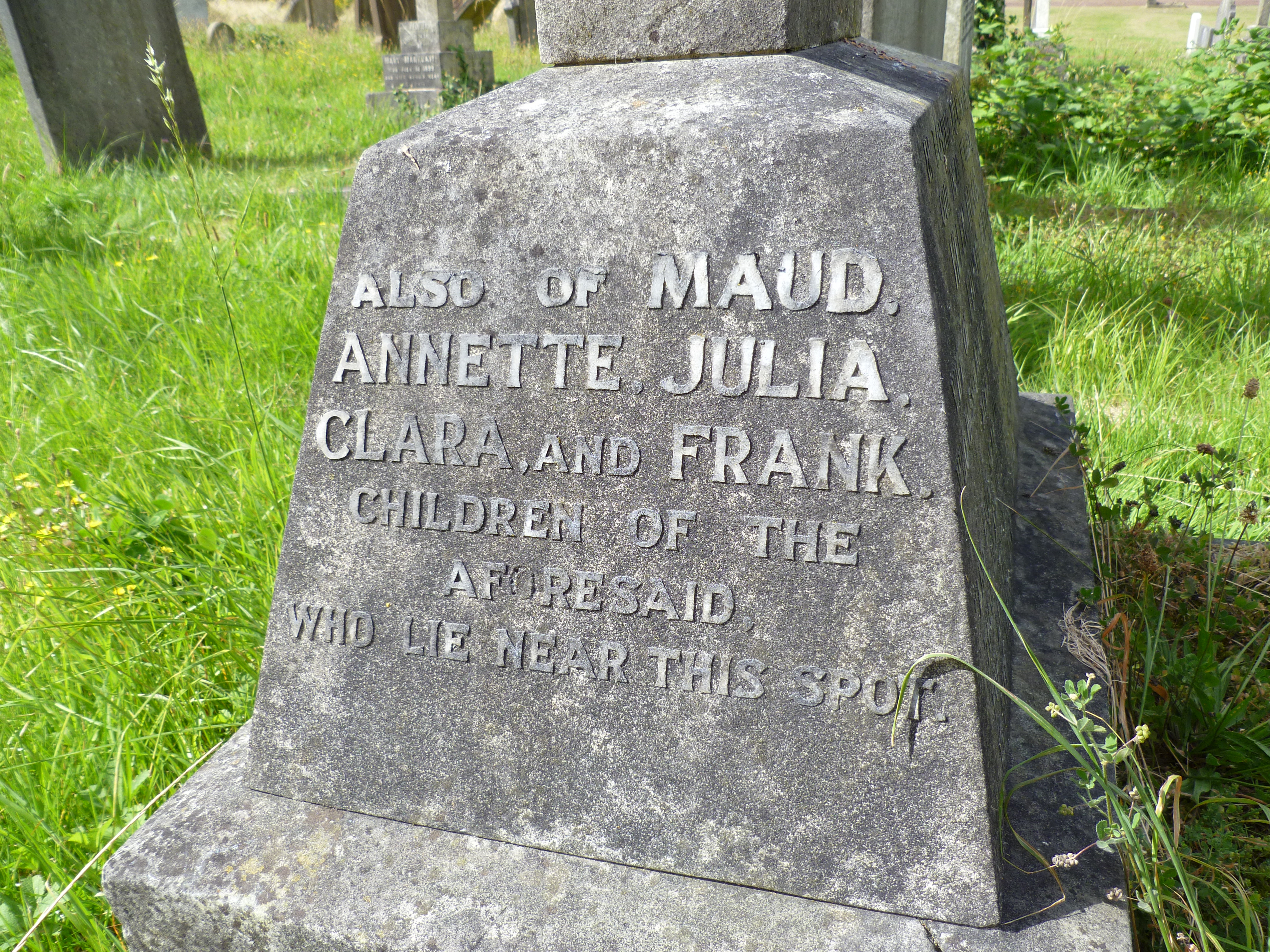
Remembering these children and the fragility of life in the 19th century compared to today makes me thankful for all the advances we have made in medicine and public health that save countless women the terrible grief of losing even one child, let alone seven. Also the invention of contraception has changed women’s lives inexorably.
For those who have lost a child, despite all those improvements in health, my heart goes out to you. As a mother, I simply cannot imagine it.
A shorter version of this story was published in the anthology “Ancestral Women” edited by Robin Stewart of Genealogy Matters under the title “Rising after Loss”.
- All sources for birth, marriage and death, as well as census records can be found on Wikitree: Helen (Chambers) Ruegg ↩︎
- Duncan CJ et al: The dynamics of scarlet fever epidemics in England and Wales in the 19th century. Epidemiol Infect, 1996 Dec; 117(3): 493-499 ↩︎


Leave a comment